Abstract
Visual Relationship Forecasting (VRF) in video aims to anticipate relations among objects without observing future visual content. The task relies on capturing and modeling the semantic coherence in object interactions, as it underpins the evolution of events and scenes in videos. However, existing VRF datasets offer limited support for learning such coherence due to noisy annotations in the datasets and weak correlations between different actions and relationship transitions in subject-object pair. Furthermore, existing methods struggle to distinguish similar relationships and overfit to unchanging relationships in consecutive frames. To address these challenges, we present SemCoBench, a benchmark that emphasizes semantic coherence for visual relationship forecasting in video. Based on action labels and short-term subject-object pairs, SemCoBench decomposes relationship categories and dynamics by cleaning and reorganizing video datasets to ensure predicting semantic coherence in object interactions. In addition, we also present Semantic Coherent Transformer method (SemCoFormer) to model the semantic coherence with a Relationship Augmented Module (RAM) and a Coherence Reasoning Module (CRM). RAM is designed to distinguish similar relationships, and CRM facilitates the model's focus on the dynamics in relationships. The experimental results on SemCoBench demonstrate that modeling the semantic coherence is a key step toward reasonable, fine-grained, and diverse visual relationship forecasting, contributing to a more comprehensive understanding of video scenes.
Dataset Statistics
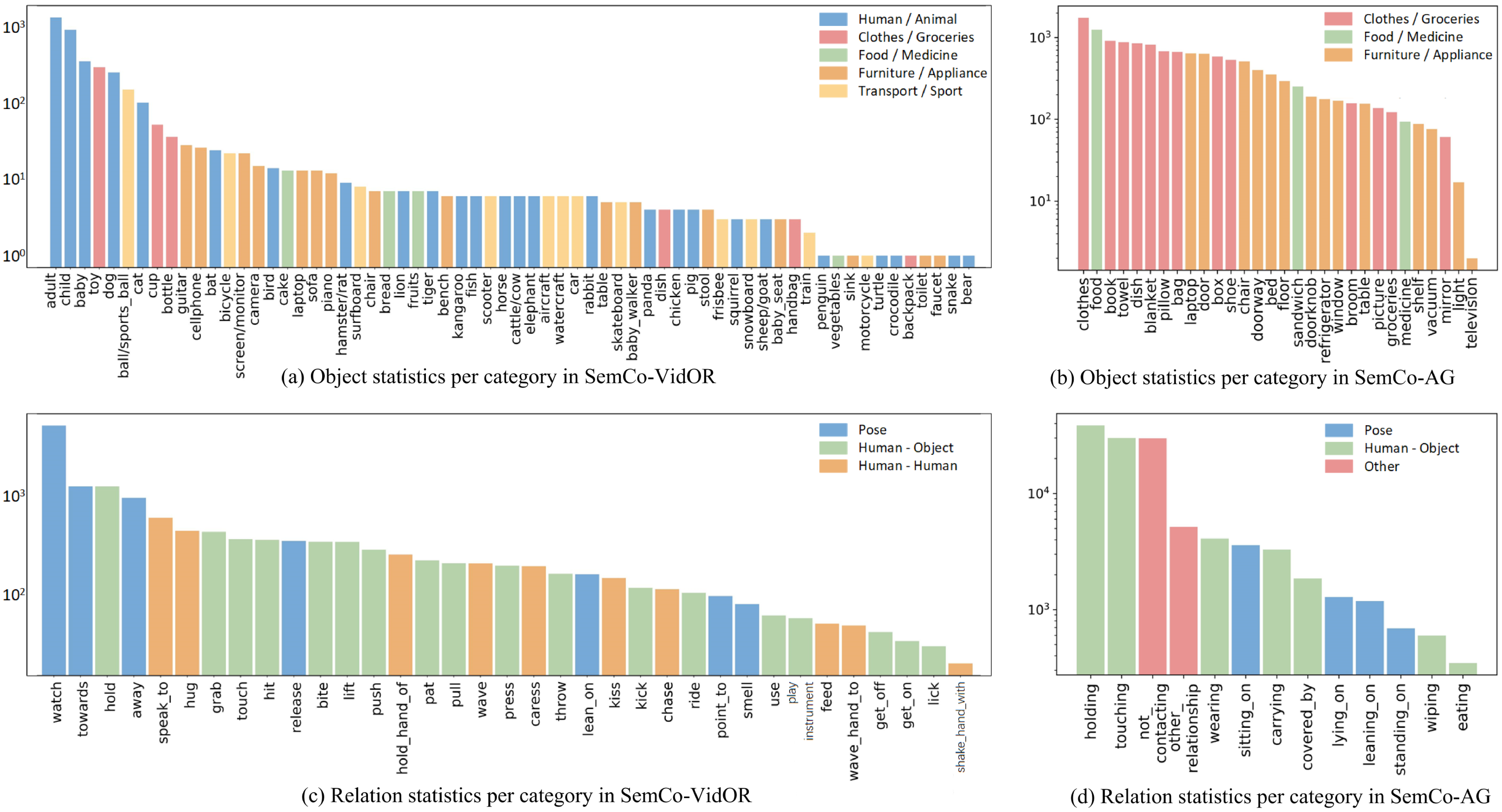
- There are 30 object categories in SemCo-AG dataset and 64 object categories in SemCo-VidOR dataset.
- SemCo-AG focuses on daily indoor objects and supports fine-grained reasoning on typical human-object interactions.
- SemCo-VidOR covers a wider range of categories, enabling richer and more diverse relational reasoning.
- There are 13 predicate categories in SemCo-AG dataset and 35 predicate categories in SemCo-VidOR dataset.
- SemCo-AG focuses on predicates for daily human‑object interactions, providing a stable testbed to validate basic relational modeling.
- SemCo-VidOR contains more predicate categories, offering a comprehensive and challenging benchmark for complex relation reasoning.
Relation Transitions
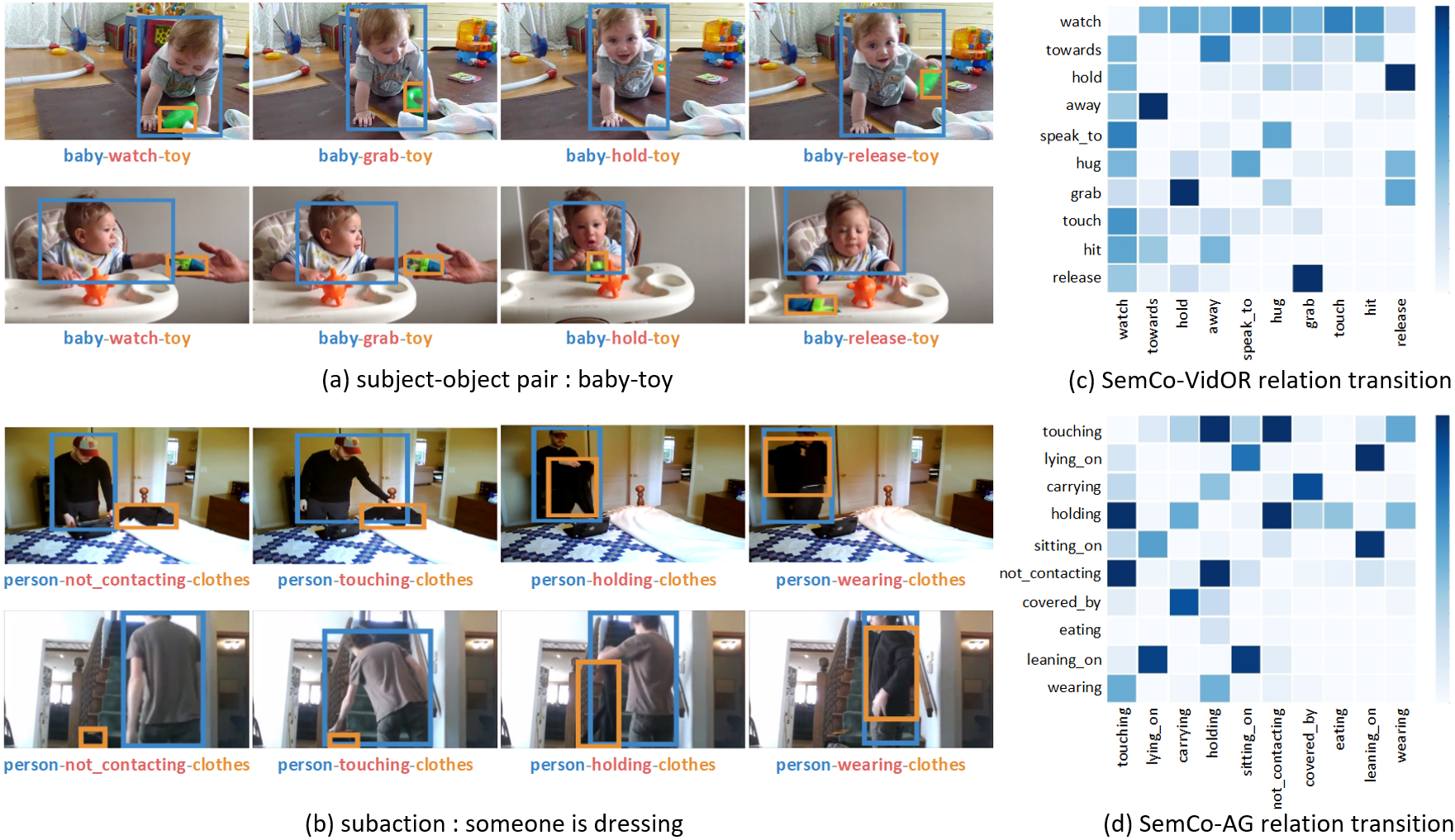
- We counted the number of all relation transitions and normalized them within each relational category, demonstrating the feasibility and significance of learning relation transitions in videos.
- We find that the possible predicate sets for a given baby‑toy pair or action annotation are similar across different visual appearances.
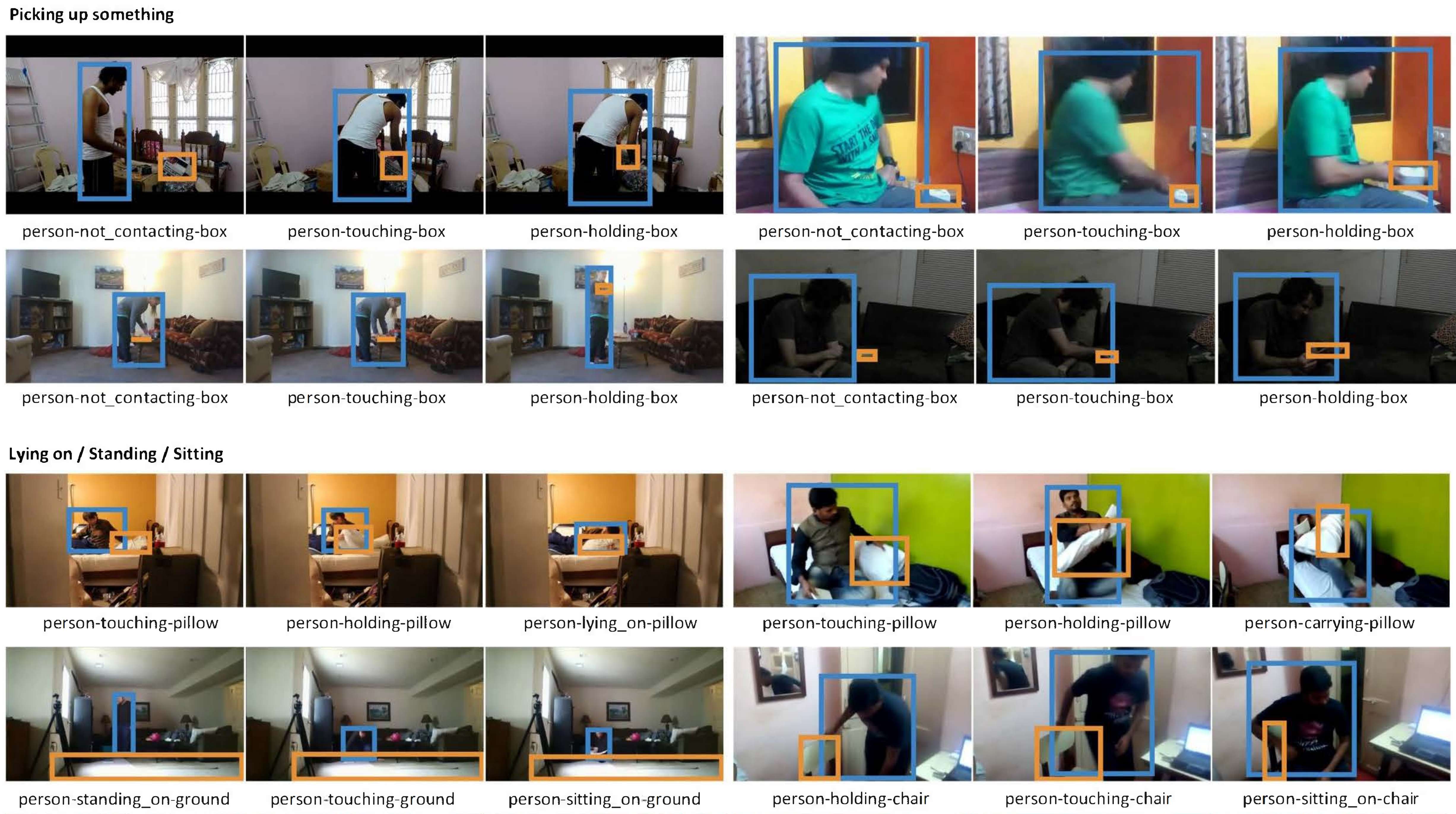
- For the SemCo-AG dataset, predicates during human picking actions follow the sequence not contacting ⇒ touching ⇒ holding.
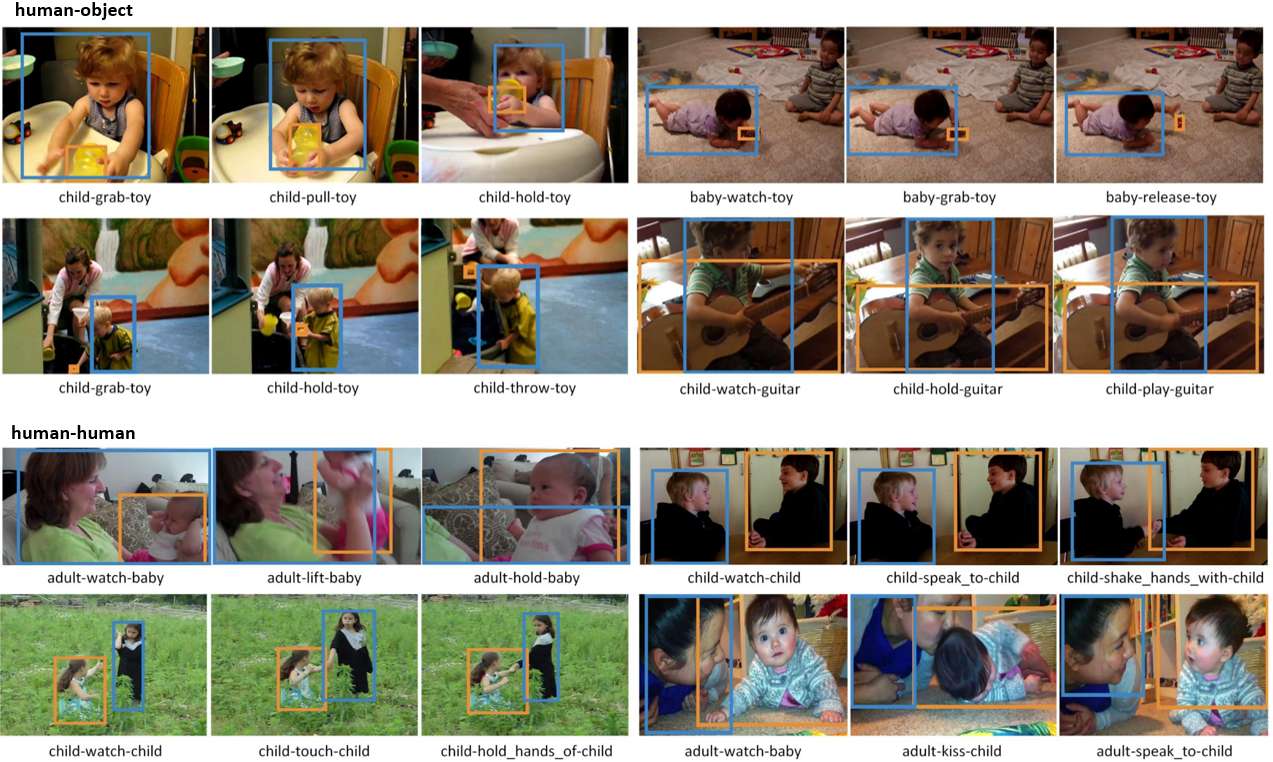
- For SemCo-VidOR, the child-toy pair exhibits the predicate sequence watch ⇒ grab ⇒ hold ⇒ release.
Object Interaction
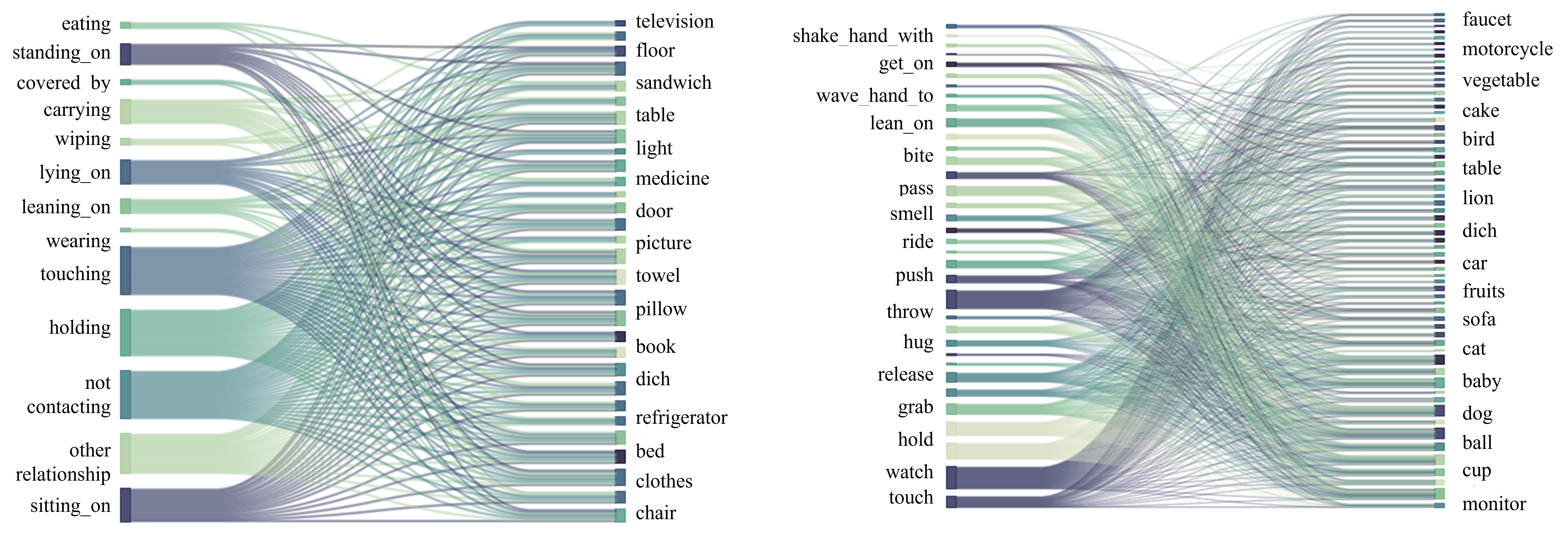
- The object-relation interactions are complicated, which also indicates that the task of predicting the video visual relationship is difficult.
- Most relations (e.g., holding, touching) interact with nearly all objects
- Few relations (e.g., eating) relate to at least four objects.
- The object count per category is comparatively balanced.
Example